The subscription economy is everywhere. It is so commonplace that subscription services have taken over business. In January of 2025, in our article entitled “Technology is Killing Freedom of Contract,” we wrote the lack of meaningful options would lead to the death of contracts.
Professors Caruso and Cox warn that the subscription economy has given rise to the growing use of “negative options” (Caruso and Cox, 2024).
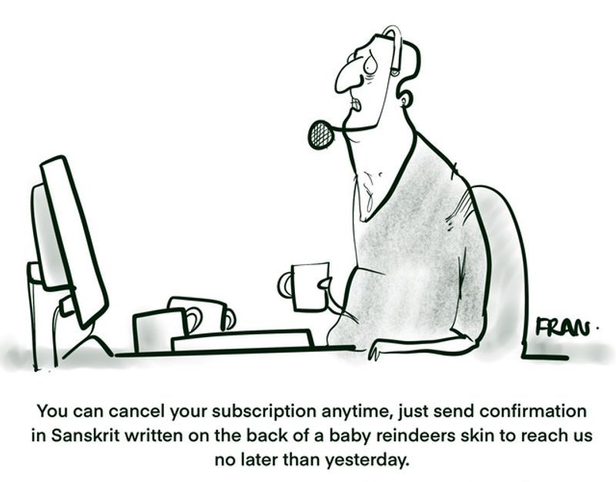
Under negative option contracts, once the customer signs up, the contract continues without end until the customer cancels, and cancellation is often difficult if at all possible.
Whether cancellation is possible may depend on the platform and whether it contains “dark patterns” (Caruso and Cox, 2024, p. 1616). Dark patterns involve a strategic manipulation by vendors to make it difficult to cancel. As one example, as some people age, they lose the ability to see blue, such that companies design hyperlinks in blue to minimize the ability of older people to cancel subscriptions (Caruso and Cox, 2024, p. 1636).
Cancellation is critical to offset the three common types of negative options:
Continuity contracts: The customer agrees to receive a good or service in advance until termination, often used by utilities, mobile phone services, and insurance companies;
Automatic renewal contracts: These contracts depend on the customer missing the deadline to cancel, allowing the contract to renew automatically; and
“Free” trial offers: Like automatic renewal contracts, companies with free trial offers expect the customer will miss the deadline for cancelation (Caruso and Cox, 2024).
Simply put, the subscription economy’s overall goal is designed so that a customer signs up one time with a click of a button, then is obligated to pay indefinitely. Some companies strategically rely on customers’ frequent misperceptions to hide the costs of the contract. Absent meaningful consent, customers sign up, do not read the tedious and lengthy boilerplate, and commit to long-term payments.
When a subscription agreement lasts several years, the amounts involved become significant, and legal intervention is justified. Don’t let these agreements take advantage of your business. We have helped many clients invalidate tricky subscription agreements to save money.
REFERENCES
Caruso, K. and Cox, P (2024). Silence as consumer consent: Global regulation of negative option contracts. American Univ. Law Rev., 73, 1611-1715.