by Tom Stilp JD, MBA/MM, LLM, MSC, DBA, December 10, 2025
In the Netflix series, Black Mirror, the episode entitled, “Joan is Awful,” Netflix pokes fun at itself as the entertainment platform, “Streamberry,” capturing the real-life events, including embarrassing moments and dark-secrets, of its customers which provide the grist for the real-time AI generated content.
When the customers go to their attorneys, they are shocked as their attorneys tell them they must sit by helplessly because the impossibly long Terms & Conditions of Streamberry’s agreement is bulletproof. The problem is that the customers state they never read the agreement.
In the episode, Joan meets with her attorney, where the following dialogue occurs:
Attorney: Well, I’ve checked it over, and I have to say that actually, . . . legally, the Streamberry Corporation can do this.
Joan: What? How?
Attorney: Trust me, I’m as shocked as you are.
Joan: But the show is using my life. It’s … it’s my name. It’s my career. It’s me. They’re … they’re using me, so . . .
Attorney: And you assigned them the right to exploit all of that.
Joan: What? When?
Attorney: Terms and conditions [sliding over a 2-inch-thick stack of paper].
Joan: I have never seen this before.
Attorney: You have. You just haven’t seen it printed out before…when you first signed up to
Streamberry. And you clicked “accept.”
Joan: What? I mean, I had – I had no – How was I supposed to know this?
Attorney: I know. But you did accept it, and so they’re in the clear.
Unfortunately, art mirrors life. We have written about this topic in prior In the Loop editions.
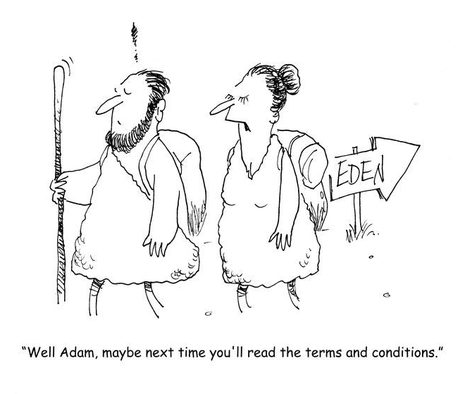
Professors Snyder and Mirabito state in the Indiana Law Review that most people do not read contracts (Snyder & Mirabito, 2019). In fact, less than 1/10th of 1% (0.001) of people who click “accept” even try to read the contract terms (Id.)
Professor Linzer writes contracts have become evil, used for bad ends and allow a distribution of power favoring shrewd businesses to force agreement (which is to say no real agreement) to capitalize on the romantic notion of freedom of contract (Linzer, 2015).
What we are left with today are contracts that are not read (too long and too complicated), only agreed to symbolically (using a click of a button), with terms that cannot be changed, and used for evil ends, leaving one party only with the option to walk away.
There is hope. We have helped clients terminate unfavorable contracts when consent was only symbolic.
References
Black Mirror, series 6, episode 1, “Joan is Awful,” directed by Ally Pankiw, aired June 15, 2023, on Nexflix.
Linzer, P. (2015). Contract as evil. Hastings Law Journal, 66, 971- 1010.
Snyder, F. and Mirabito, A. (2019). Boilerplate: What consumers actually think about it. Indiana Law Review, 52, 431- 453.
¹In the Loop editions include articles such as “Technology is Killing Freedom of Contract,” “The End of Contracts (or The Contract as Evil)” and “What is Product that You Hope You Will Never Have to Use, and When You Have to Use It, You Generally Cannot?” In each of these articles, we describe contracts that are too long and too complex such that no one actually reads them.