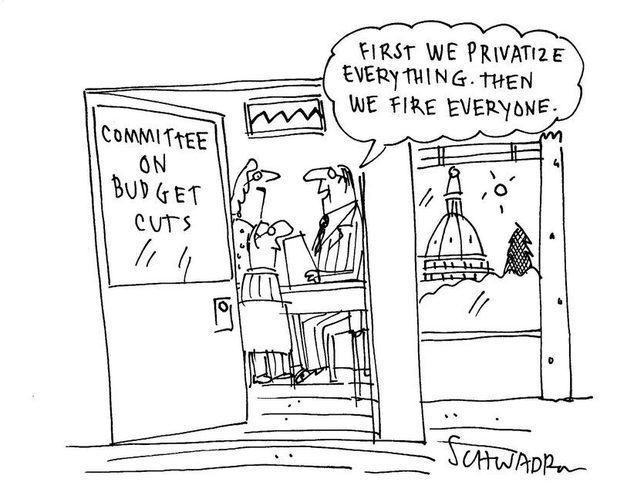
The privatization of traditional government services is growing.
As an example, for over 100 years, the Cook County Recorder of Deeds had been charged with faithfully recording documents, affecting billions of dollars of real estate in the County each year. Then the Recorder’s Office was permanently dissolved. The Recorder’s services were subsumed by the County Clerk. The County contracted with private companies to perform the Recorder’s functions.
In effect, the government out-sourced work. Doing so, the County has ceded its authority to private companies. One could argue if the private companies work faster, cheaper and better, then the move to privatize work is good. There are, however, a few considerations.
The Recorder of Deeds was an elected position. In theory, the Recorder was accountable to the public. But private companies are not accountable to the voters.
Another curious problem – private companies charge fees, registration and annual subscription costs which can amount to thousands of dollars. Thus, without any reduction in taxes for services the government no longer performs, the overall cost to the public has increased.
Third, records, as those kept by the Recorder’s Office, are “public.” As “public” records, the people are supposed to have access to the records without charge. The law states the following about public records:
“All records, dockets and books required by law to be kept by such clerks shall be deemed public records, and shall at all times be open to inspection without fee or reward, and all personal shall have free access for inspection and examination to such records . . . “ 705 Ill. Compiled Statutes 105/16(6) (2020).
According to the U.S. Supreme Court, free access to public records, based on the 1st Amendment, includes the right to freedom of speech, which carries with it the freedom to listen to public proceedings and have access to records. Richmond Newspapers v. Virginia, 448 U.S. 555 (1980).
There are not any court challenges to the privatization of government services, perhaps because the courts themselves are taking the same actions and privatizing many of their services. The old days when an attorney would “spindle a motion” in front of the Clerk, or file a paper document with the Clerk, who would “file-stamp” the document and give back a copy, are gone. Now, attorneys scan their own documents, upload, file and and even label the documents in the Court system, doing the Clerk’s job.
Those of us who work regularly with public officials, clerks and ministerial personnel have seen the biggest changes. Knowing how to adapt is the difference between those who succeed in the new system and those who don’t.