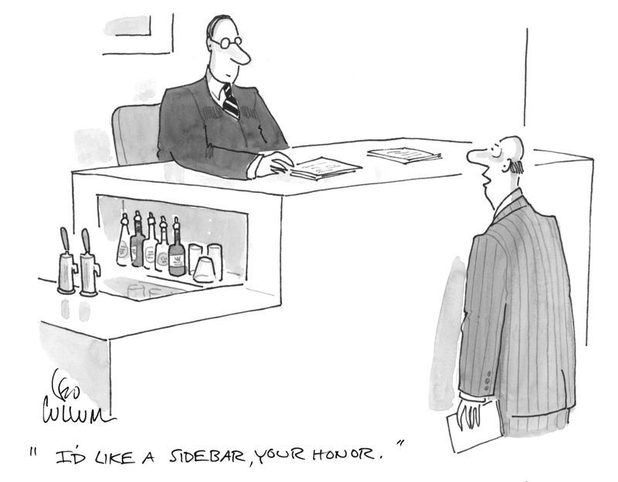
Anyone following the recent Lindsay Clancy trial will note the frequent use of “sidebars.” Having taken over 150 cases to trial, we thought we would explain what a sidebar is and when it is used in a jury trial.
Technically, the sidebar is the area in front of or next to the bench, apart from the witness stand, where the witness is testifying, and away from the jury box.
Judges will often call attorneys to speak confidentially with the judge so that the jury cannot hear what is discussed.
A sidebar saves time such that the judge does not have to excuse the jury (that is, have the jury leave the courtroom) when there may be sensitive or inadmissible evidence that could unfairly affect the jury. A sidebar is a recognition that you cannot “un-ring the bell” if the jury were to hear something improper. Lawyers and judges use the sidebar, out of the hearing of the jury, to argue points vital to the trial.
In our experience, there are different ways of handling sidebar conferences. Perhaps the most extreme method occurred during our three (3) week trial before federal district court judge, Sam King.
Sam King, one of the oldest federal judges from district court of Hawaii, always came to Chicago during the summer. We had a three (3) week long trial involving “reverse sexual harassment.” Our client was a person in a high position within the company accused of sexually harassing a man. During our trial, Judge King’s reputation attracted other federal judges, who watched and attended the trial.
Judge King did not believe in sidebars, so everything had to be argued in front of the jury.
Each morning before the jury came into the courtroom, my opponent had a dozen members of his mega-firm organizing files, documents and notes. When the jury entered the courtroom, they would see only little-o single attorney, and me with my (then) firm of three attorneys (including me) seated at Counsel’s table.
One day during trial, my opponent became especially irate at a point I was trying to make with one of his witnesses, and said to the effect: “Mr. Stilp has three attorneys working on this case, and there is only me.” I objected and, without a sidebar, said: “The jury does not see that my opponent has a dozen lawyers from his mega-firm here every morning. The jury sees my whole firm right here, and we have nothing to hide.” He, of course, objected, and Judge King only laughed and said, “Overruled – you brought it up.” I could see jury members smiling, a sign of how the case would turn out for us.
Other judges require that attorneys leave the courtroom and go into chambers for the sidebar. One judge would have me go into the hallway, without a court reporter, and then come back into the courtroom and summarize to the court reporter, outside the presence of the jury, what was said at the sidebar.
There are thousands of issues that arise during a case, and sidebars present unique opportunities. Having experienced trial counsel on your side will make the difference. Points raised at sidebar conferences often determine the outcome of the case.